Initialising the digital twin...
Research project · Mawhiba · King Faisal University
Living bacteria
that make electricity
BioVolt is a microbial fuel cell where Geobacter bacteria eat organic waste and hand their electrons to an electrode. A digital twin and an AI supervisor read every signal, diagnose trouble within ten minutes and keep the colony alive and productive.
Live power outputLIVE
271µW+36.5% vs 1 kΩ
Voltage
0.283 V
Current
0.96 mA
Health
100%
AI supervisor
All signals nominal. Tracking maximum power.
WhyBioVolt?
Wastewater carries 1.7 to 2.1 kWh of chemical energy in every cubic metre, yet treatment plants spend about 0.3 kWh/m³ just blowing air into it. In a microbial fuel cell the bacteria do the cleaning and pay for it in electrons. The catch: the colony is alive. A pH dip, a cold night or a toxic pulse can halve the output or kill the biofilm, and by the time a human notices, days of energy are gone. BioVolt watches the cell like a doctor, with physics it can explain.
0C
charge locked in every gram of COD
0.00V
Nernst ceiling of an acetate cell
0.000V
model open-circuit voltage (0.798 measured)
0.0h
biofilm doubling time (6 to 8 h in the lab)
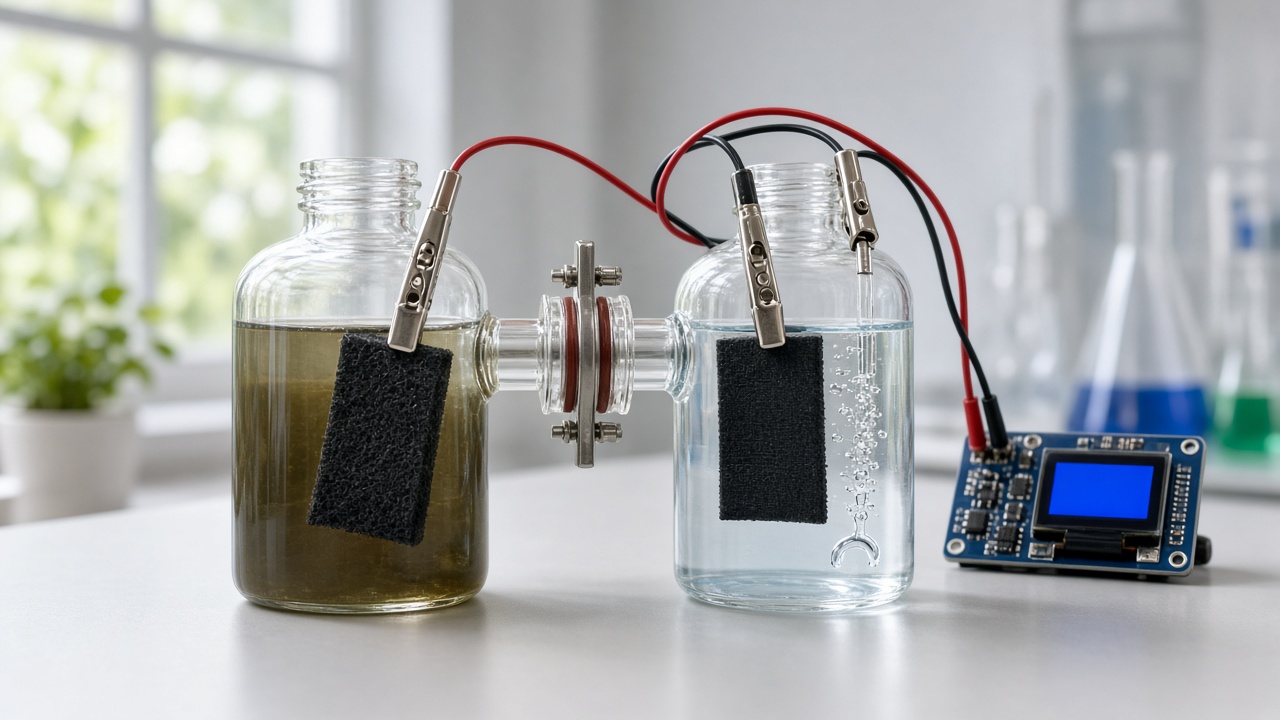
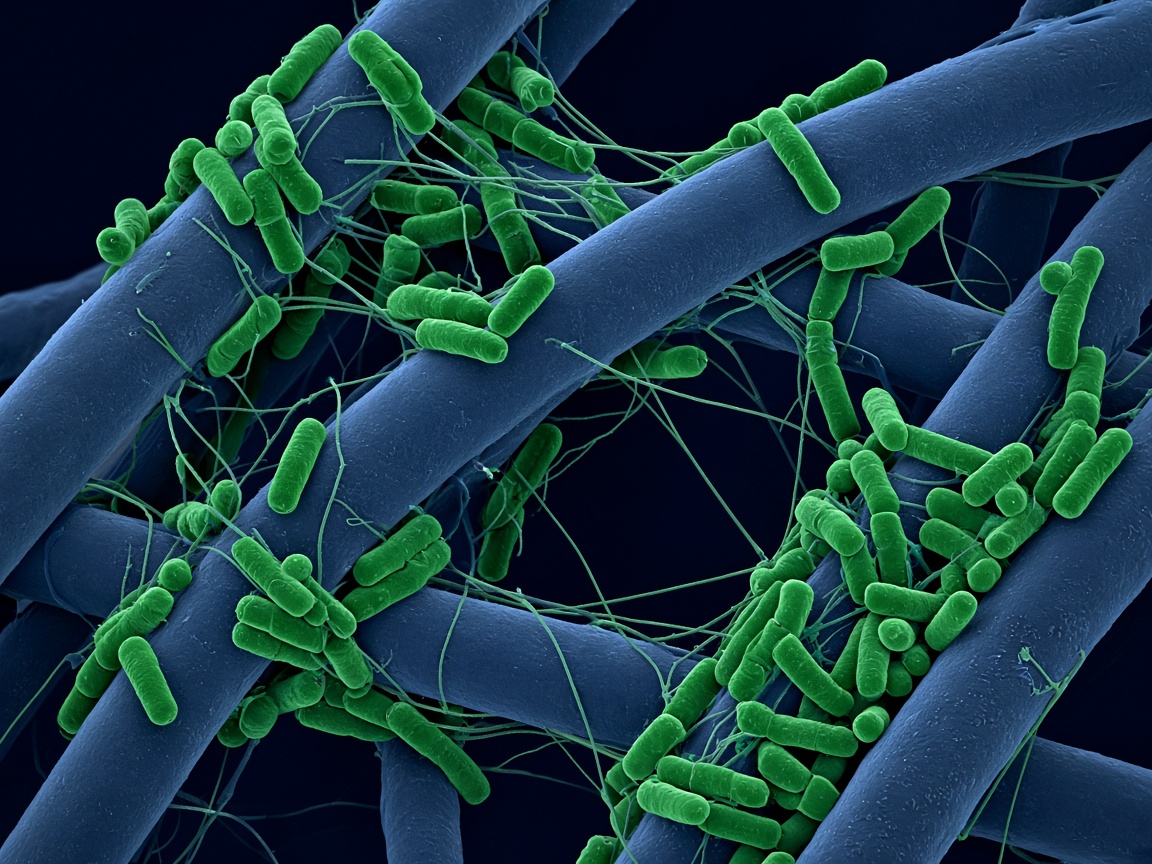
Same cell, same shock
From a fixed resistor
to a cell that thinks
Ten simulated days, a severe acid shock at hour 72, identical bacteria. The only difference is who is in charge.
Before · passive
The conventional cell
- A fixed 1 kΩ resistor, chosen once and never revisited
- A severe acid shock drops power to almost zero
- 45 hours to climb back, 12% of ten days' energy lost
- Blind MPPT chases the collapse and traps the cell: 59% lost, never recovers
- A drifting pH probe is trusted, and the operator doses the wrong way
After · BioVolt AI
The supervised cell
- A digital twin fitted to the sensors every 10 minutes
- The shock is diagnosed in the first cycle, buffer dosed before pH falls below 6.8
- 0% energy lost in the same 10-day run
- Model-assisted MPPT harvests about 37% more energy every normal day
- Sensor faults are caught by cross-checking the twin, and dosing is blocked
Figures from the Recovery Lab running on this site's live engine. Re-run them yourself.
Open the Recovery LabLive dashboard
Watch the colony breathe
This is not a recording. A simulated cell is running in your browser right now: electrons flow at the speed of the real current, the biofilm thickens as it grows and the chamber tints as pH drifts.
Power
271µW
Power density
109mW/m²
Coulombic eff.
16%
Health
100%
Power, last 16 h · AI vs fixed 1 kΩCOD −34%
01
A digital twin
Faraday, Nernst, Butler-Volmer and Monod kinetics solved every minute of simulated time, then corrected against the sensors.
02
An AI supervisor
Eleven fault signatures scored in parallel. Every action comes with its cause, the physics behind it and a prediction you can check.
03
Honest numbers
Microwatts, not kilowatts. Every figure on this site comes from the same engine you can open in the Calculation Lab.
The AI supervisor
An operator that reasons with physics
Not a chatbot and not a black box. Every ten simulated minutes it compares what the cell does with what physics says it should do, names the most likely cause and acts. Faults caught inside 15 minutes recover fully; untreated acid shocks took 60 hours on average in the literature.
BioVolt AI supervisor
● Online · model confidence 100%
Try it: break the cell
Acid shock8%
Organic overload6%
Food starvation4%
Waiting for the next supervisory cycle…
01
Estimate
The twin predicts voltage, pH and current from the inputs alone, then assimilates the sensors to learn the hidden biofilm state.
02
Detect
A CUSUM on the gap between sensor and twin flags drift long before a threshold alarm would.
03
Diagnose
Eleven physical signatures are scored at once. pH falling first means acid. Current falling with normal pH and temperature means something is killing cells.
04
Act and explain
Buffer, isolate, feed, heat or re-tune the load, each with its cause, a testable prediction and a confidence score.
How it works
From waste to a current
01
Feed
Wastewater or blended food waste enters the sealed anode chamber. Dissolved sugars and acids are ready at once; solids must first be hydrolysed, which is why a one-day retention time unlocks only about 5% of them.
Xp → S (k_h · f_T · f_pH)02
Breathe
Geobacter oxidises acetate and, with no oxygen around, breathes the electrode instead. Each acetate molecule releases eight electrons through conductive pili and cytochromes.
CH₃COO⁻ + 4H₂O → 2HCO₃⁻ + 9H⁺ + 8e⁻03
Flow
Electrons travel through the external load. Faraday's law sets the exchange rate: one gram of COD is worth 12,061 coulombs, so every microamp can be traced back to grams of waste removed.
Q = n·F·(ΔCOD/M) = 12,061 C/g04
Close
Protons cross the membrane and meet oxygen and electrons at the cathode, making water. The cathode, not the bacteria, is usually the bottleneck: biofilms can deliver 3 to 7 A/m² while real cells draw 0.1 to 0.4.
O₂ + 4H⁺ + 4e⁻ → 2H₂O05
Supervise
Every ten minutes the AI compares sensors with the twin, diagnoses, and adjusts the load, buffer, feed or heat. Once a day a lab COD sample recalibrates it.
P = V² / R_ext → R_ext* ≈ R_intThe project in pictures
From a bench prototype to a thinking plant
The physical cell, the electronics that read it, the waste it eats and the scale it could reach.
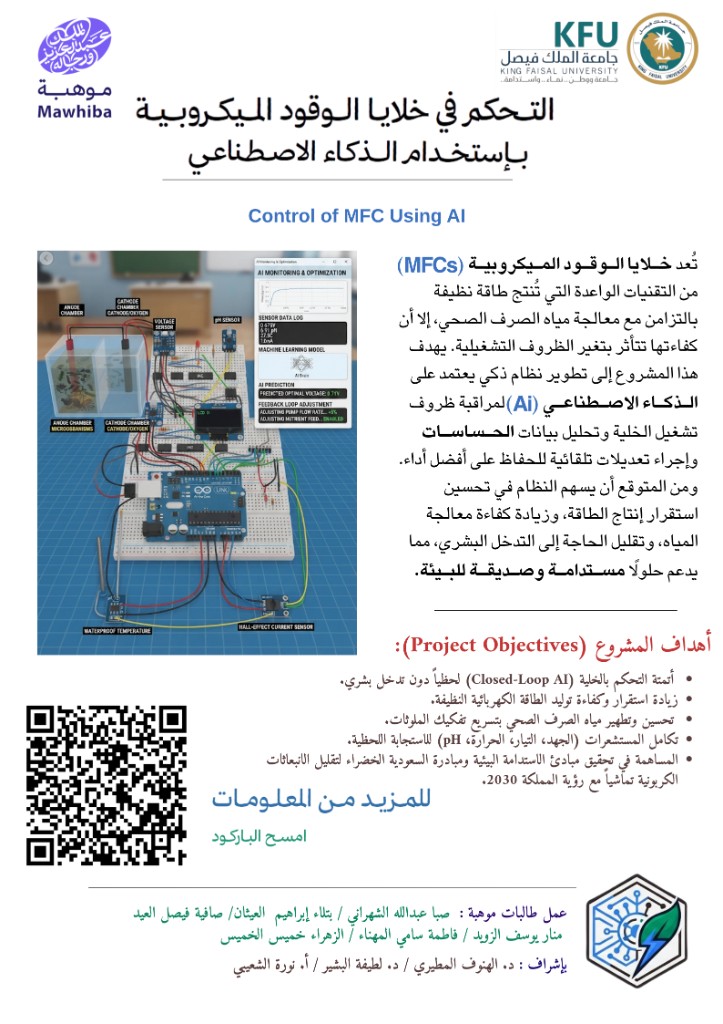
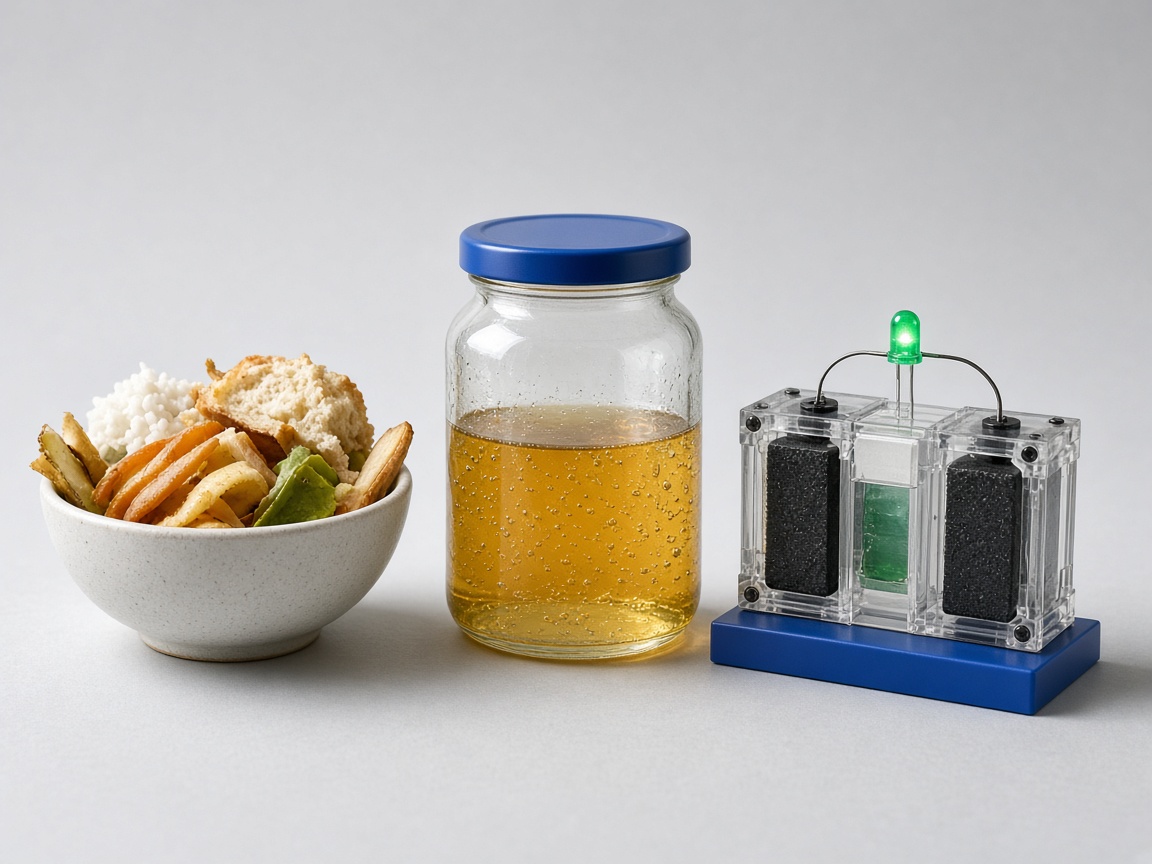
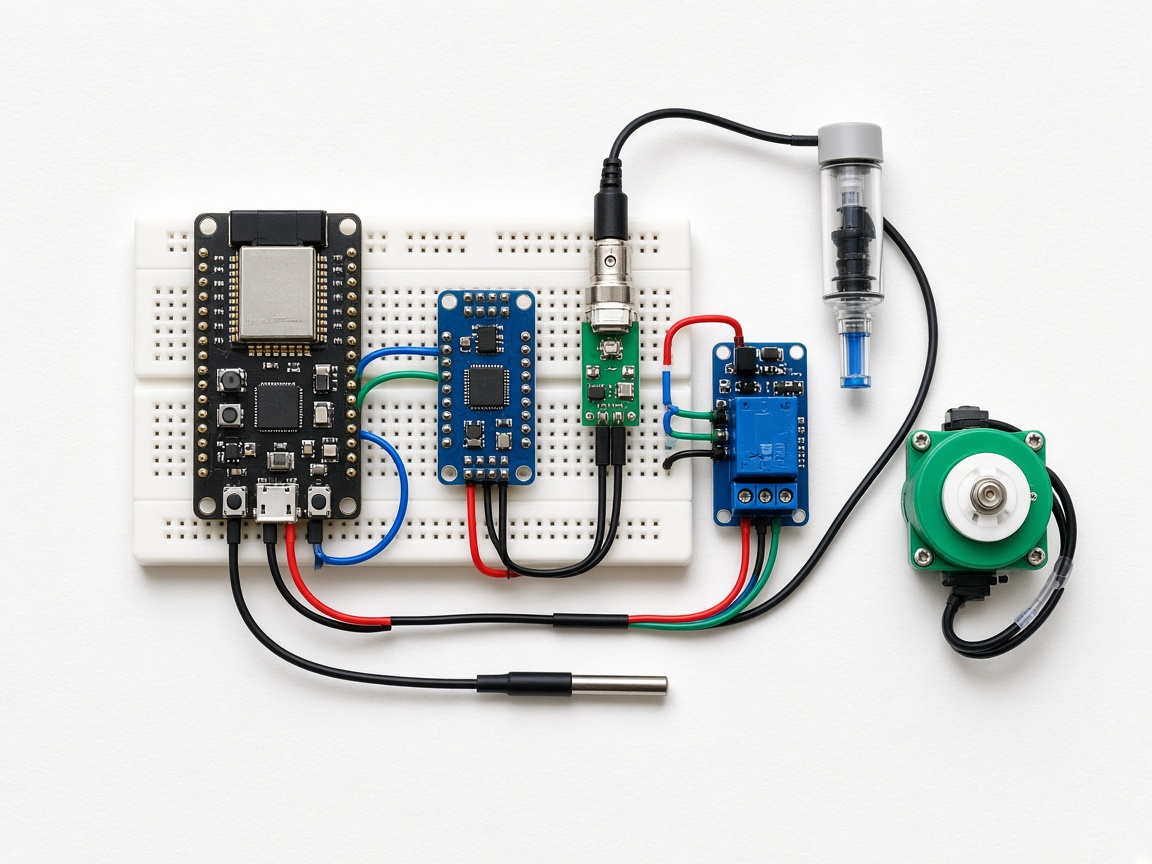
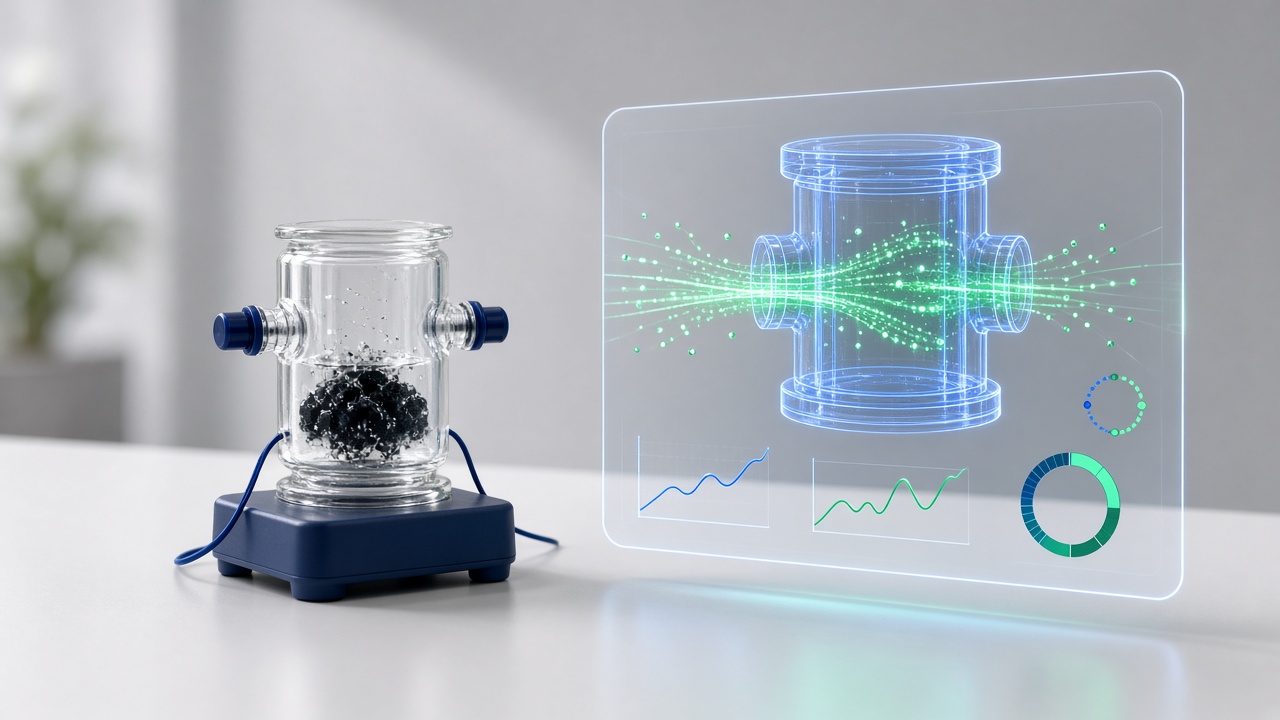
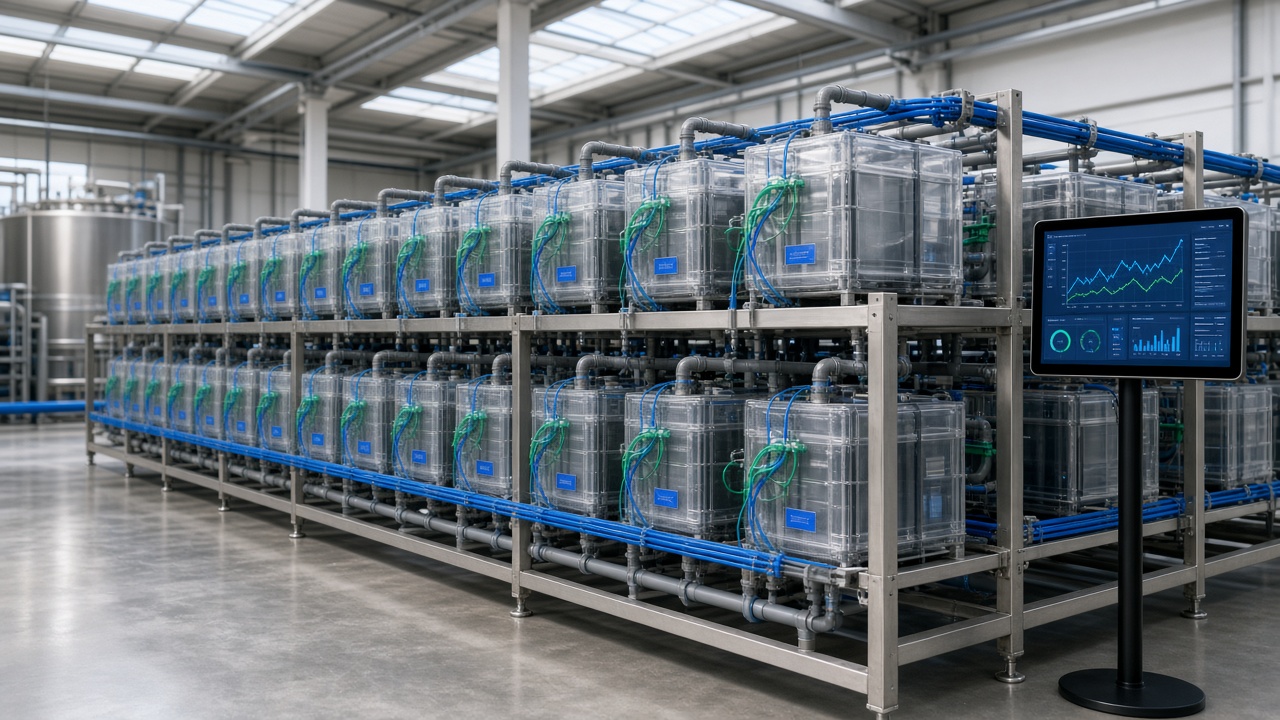
The first photo is the team's prototype. The others are illustrations generated for this site.
Applications
Where a living battery makes sense
Not the grid. The best 1000 L pilot recovered 0.033 kWh per cubic metre. The value is treatment with less energy, and power exactly where wires cannot reach.
Wastewater treatment
Clean water without blowing air. Aeration is the biggest power bill of a treatment plant, and sludge yield drops about 4.7 times.
Self-powered sensors
A 3.4 mW sediment cell ran a 2.5 W buoy in bursts by charging a capacitor. No batteries to replace at sea.
Toxicity early warning
The biofilm is a living detector. A sudden current drop with normal pH and temperature means something toxic arrived.
Off-grid sanitation
PEE POWER stacked 432 cells to light festival toilets with about 300 mW, turning waste into safety lighting.
Food waste valorisation
Reported power from solid food waste ranges from 1 to 371 mW/m², and up to 1540 when the waste is fermented first.
Teaching and research
Electrochemistry, microbiology and control theory in one living system, with a twin that shows every hidden variable.
Questions
Straight answers
Your turn
Break the cell.
Watch it heal.
Inject an acid shock, a toxin or a failing sensor, then watch the AI diagnose it in real time. Or open the lab and check every equation yourself.