Initialising the digital twin...
Hardware
Electronics that listen to microvolts
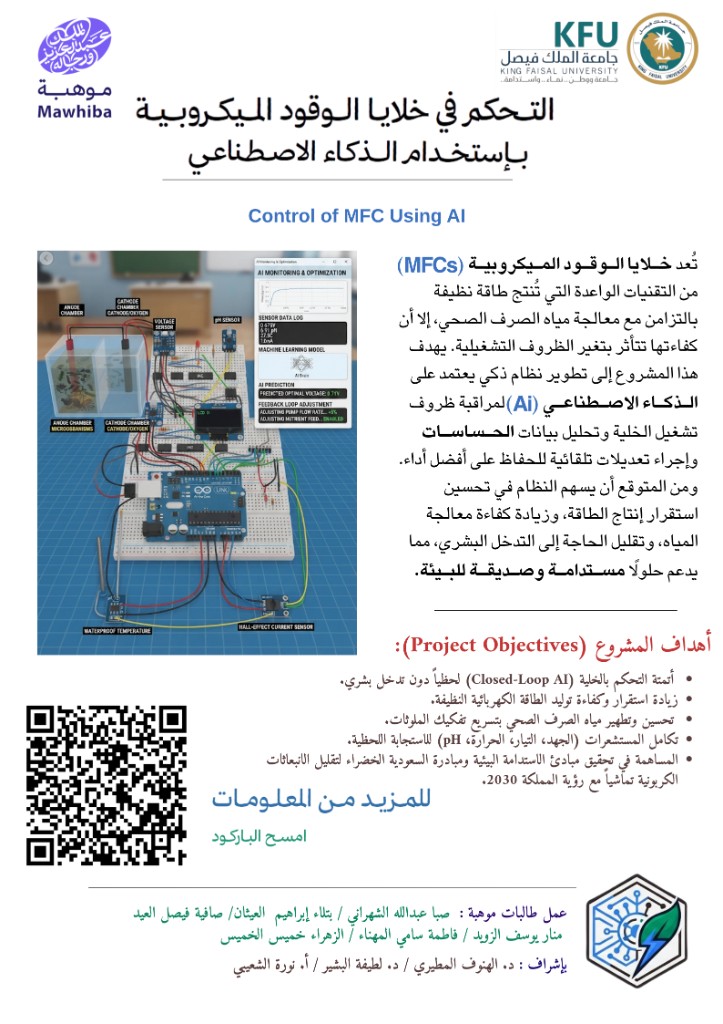
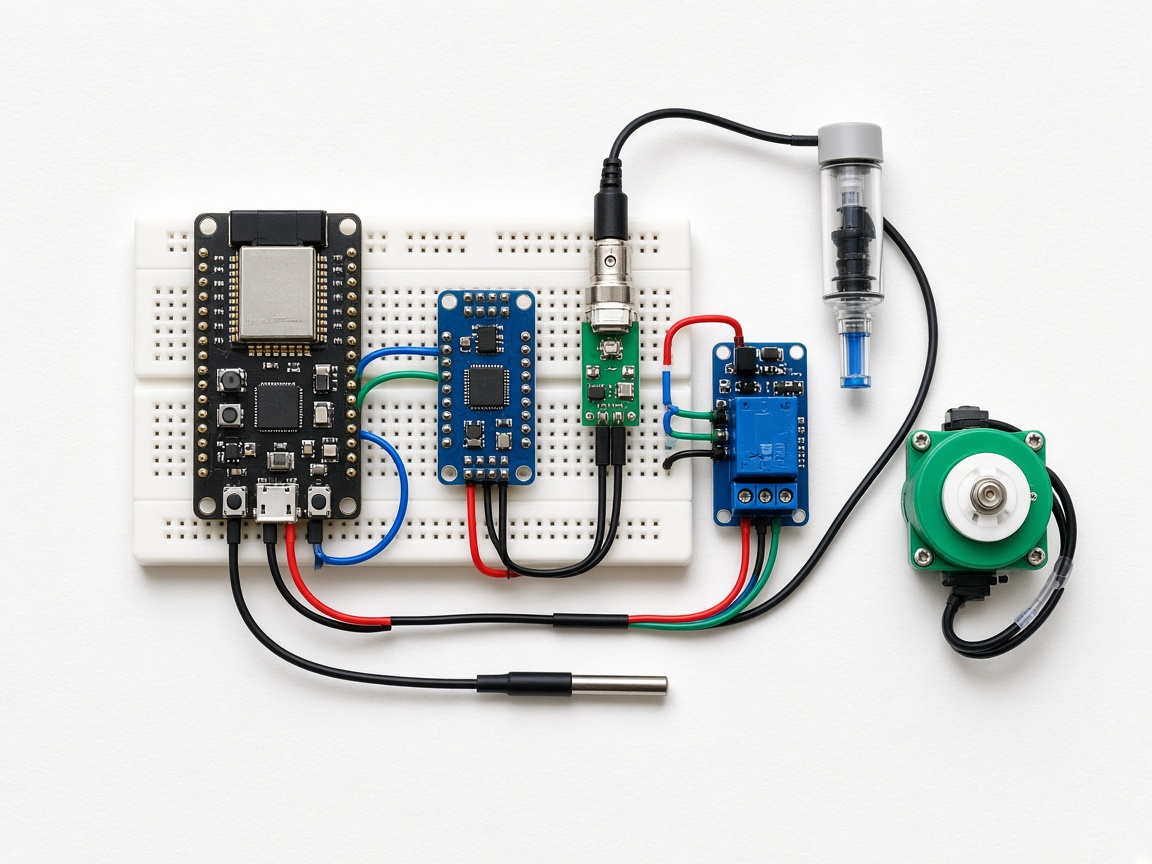
An ESP32 brain, a 16-bit converter, a reference electrode and a handful of industrial probes. Built to read a living cell without disturbing it, and to act on it only when it is safe.
Signal chain
From bacteria to decision and back
Sensors feed a precision converter, the ESP32 talks to the twin, and every action returns to the cell through a safety gate. Values are live.
Living cell Sensors Brain Actuators Power out
Tap any block. Highlighted wires show where its signal goes.
Ag/AgCl reference
+0.210 V vs SHE (3 M KCl) through a buffer amplifier
The most important smart sensor. It separates bacterial problems from cathode problems, which is what lets the AI name the cause.
Probe reads (vs Ag/AgCl)
-0.423V
Anode potential
-0.213V SHE
Precision
A living cell whispers in microvolts
A cell with 0.7 V open circuit and 1.3 kΩ internal resistance peaks at about 94 µW, 0.27 mA and 0.35 V. The electronics must resolve microamps and millivolts, so two popular parts had to go.
10 µVsmallest step it can see (log scale)1 V
ACS712noise ≈ 114 mA × 185 mV/A
Noise is 50 times the whole cell current, and it draws 10 mA itself.
ESP32 ADCblind below 150 mV
Nonlinear, with a dead zone that swallows a starving cell.
Arduino ADC4.9 mV per step
Too coarse to see the MPPT's small steps.
ADS111531.25 µV per step
Resolves 11,200 steps at a typical 0.35 V operating point.
Shorter bars are better. The blue tick marks 0.35 V, the cell's working voltage.
Bill of materials
Eleven parts, each with a reason
The corrected list from the research. Every part answers a specific measurement or control problem.
Compute
ESP32
240 MHz · Wi-Fi · MQTT
Sends data to the digital twin and runs the safety rules locally. Its own ADC is never used for measurement.
Measure
ADS1115 × 2
16-bit · 31.25 µV/step
Reads cell voltage and the reference electrode. Current is computed as V divided by the known external resistance.
Act
Resistor bank
10 Ω to 100 kΩ · relays
The load the MPPT moves and the sweep for polarisation curves. A digital pot tops out at 1 mA.
Measure
Ag/AgCl reference
+0.210 V vs SHE · buffered
Measures the anode alone, so a bacterial problem is never confused with a cathode problem.
Measure
DS18B20 × 2
±0.5 °C · 1-Wire
Temperature for the biology and for compensating pH and conductivity.
Measure
DFRobot SEN0169-V2
±0.1 pH · 24/7
Industrial probe built for continuous immersion, output safe for 3.3 V logic.
Measure
DFRobot DFR0300
EC · K = 1
Conductivity sets the ohmic loss; its drift reveals salt and fouling.
Measure
DFRobot SEN0237-A
DO · 0 to 20 mg/L
Oxygen at the cathode, or a leak into the anode.
Measure
INA226
mA side · I²C
Measures what the boost converter actually delivers to the LED.
Power
BQ25570 + supercap
1 to 50 F · cold start
Stores microwatts and releases them in useful bursts.
Act
Pumps + heater
feed · buffer · heat
The hands of the AI: feed rate, bicarbonate dose and temperature.
Firmware
One patient loop every ten minutes
The cell's dynamics are slow, so the controller is too. Perturb and observe steps every 5 to 15 minutes; faster makes the system oscillate.
Hard rules live on the device
The AI suggests. The firmware decides if it is safe.
- Never lower the resistance if the cell is below 0.1 V
- Below pH 6.5, dose buffer immediately
- Cool above 40 °C, heat below 20 °C
- Change only one major variable per cycle
- Log every automatic decision with its reason and prediction
// Runs on the ESP32. The network cannot override it.
bool safeToApply(const Action& a, const Readings& r) {
  if (a.lowersResistance && r.V < 0.10) return false; // reversal risk
  if (r.pH < 6.5 && !a.dosesBuffer)       return false; // buffer first
  if (r.T > 40.0 && a.heats)              return false; // never heat a hot cell
  if (a.majorChanges > 1)                 return false; // one lever per cycle
  if (a.pumpRate > MAX_PUMP)              return false; // washout guard
  log(a, r);                                             // every decision explained
  return true;
}
Live telemetry packet
mqtts://twin/biovolt-01/telemetry
{
  "id": "biovolt-01",
  "t": 0,
  "v": 0.28263,
  "i_mA": 0.9601,
  "e_an": -0.2131,
  "ph": 7,
  "ph_q": "ok",
  "temp": 30,
  "do_an": 0.02,
  "r_ohm": 200,
  "r_ext": 280,
  "conf": 100
}
Values stream from the simulated cell running in this browser.
Calibration
How the twin becomes this exact cell
Daily to weekly
Polarisation sweep
Step the load from 10 kΩ down to 10 Ω, wait for steady state, record V and I. The slope gives Rint; the shape gives the cathode i₀ and the bacterial jmax.
Every cycle
Current interrupt
Open the circuit for a moment. The instant jump in voltage equals I × Rohm, which tracks fouling in real time.
Once a day
Lab COD
A two-hour lab test corrects the twin's estimate of food in the chamber and gives the true coulombic efficiency.
Continuous
Kalman update
An extended Kalman filter slowly re-fits qmax, Ks and decay so the twin stays true to this particular cell.
The prototype
Built on a bench, tested in software first
Every part above has a twin inside this website. Break it in the monitor, size it in the calculation lab, then wire the real one with confidence.