Initialising the digital twin...
Learn
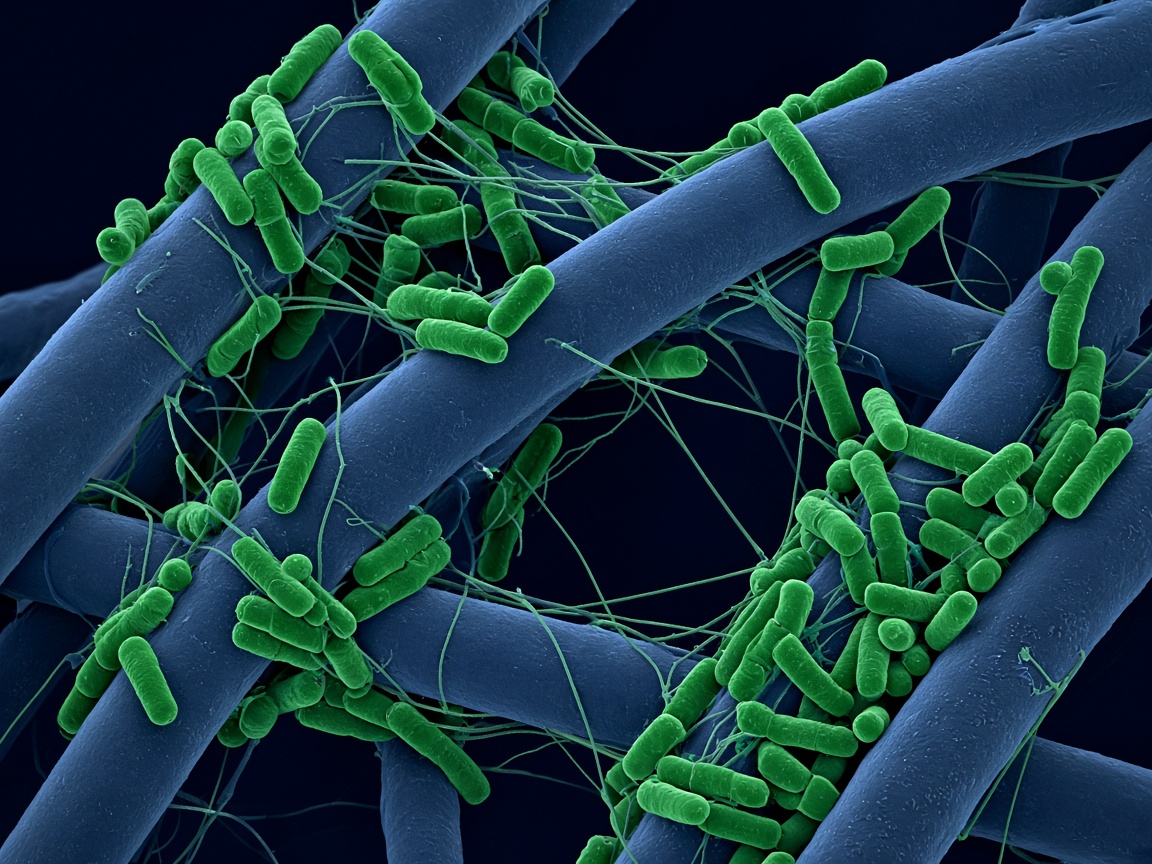
Meet the bacteria that breathe on metal
No textbook walls. Grow a colony, follow one electron from lunch to light, see where the volts disappear, then test yourself.
Life of the bacteria
They grow, divide and die, like us
Every beat runs the same Monod, Rosso and decay equations as the engine. Starve them, chill them, poison them, and watch the colony answer.
Thriving: dividing fastt = 0 h
Alive
0
Born
0
Died
0
Doubling
8.6 h
f(T)
1.00
f(pH)
1.00
Monod
0.87
Births: μ = 1.94 per day. Deaths: b = 0.04 per day, always. The colony stops growing near 150 cells because space on the anode runs out, the same crowding that caps a real biofilm at about 2.7 g/m².
The electron journey
From lunch to light
01 / 06
Food arrives
Dissolved organics such as acetate diffuse into the biofilm on the anode. No oxygen here, so the bacteria cannot breathe the normal way.
Three ways out
How a microbe plugs into a wire
cytochromes
Direct contact
Proteins studded with iron hemes sit in the outer membrane and pass electrons straight to the surface the cell touches.
conductive filaments
Nanowires
Geobacter grows conductive filaments that let cells tens of micrometres from the anode still deliver current through the biofilm.
mediators
Shuttles
Some species release small molecules that carry electrons to the electrode and come back for more, like a ferry.
Where the volts go
1.10 V in theory, much less at the wire
Computed live from the simulated cell. The cathode usually eats the most, which is why better cathodes, not better bacteria, are the big research frontier.
1.10
-0.54
-0.09
-0.19
0.28
Nernst ceilingCathode: oxygen is slowAnode: bacteria need a pushOhmic: water resistsDelivered to the load
Volts. Live state: 30.0 °C, pH 7.00, load 271 µW.
Glossary
Speak fuel cell
Anode
The electrode the bacteria live on and hand their electrons to. Kept free of oxygen.
Cathode
The electrode where oxygen accepts the electrons and becomes water. Usually the biggest source of loss.
Biofilm
A living layer of bacteria glued to the anode, about 50 µm thick when mature.
Geobacter
The best known electroactive bacterium. It can pass electrons outside its body to metals and electrodes.
COD
Chemical oxygen demand: how much oxygen it would take to burn the organics in the water. 8 g COD carries one mole of electrons.
Coulombic efficiency
The share of electrons in the food that actually reached the wire. The rest fed growth, methane or oxygen.
Open circuit voltage
The cell voltage with nothing connected. About 0.8 V for acetate and air, below the 1.10 V ceiling.
Internal resistance
All losses inside the cell lumped into one number. Power peaks when the load equals it.
MPPT
Maximum power point tracking: nudging the load up or down and keeping whichever direction raised the power.
Polarisation curve
Voltage and power measured across many loads. Its shape reveals which loss dominates.
Nernst equation
Sets an electrode's potential from temperature and concentrations. It fixes the thermodynamic ceiling.
Monod kinetics
Growth rises with food and then saturates: S / (Ks + S), with Ks = 119 mg/L for anode bacteria.
Doubling time
How long a population takes to double. 6 to 8 hours measured on anodes.
Hydrolysis
Breaking solids into dissolved molecules. The slow first step for food waste.
HRT
Hydraulic retention time: how long water stays in the reactor on average.
Digital twin
A live model of this specific cell, updated from its sensors, used to test decisions before applying them.
CUSUM
A statistical test that adds up small deviations until they prove a real change.
Reference electrode
A stable electrode (Ag/AgCl) that lets you measure the anode alone instead of the whole cell.
Methanogens
Microbes that compete for the same food and turn it into methane instead of current.
Supercapacitor
Stores energy slowly and releases it fast, turning microwatts into a useful burst.
Quiz
Eight questions, real numbers
1 / 8Score 0
How much electric charge is stored in 1 g of COD?
Ready to put numbers on it?